Current Research

1
Metabolic Health and Well-Being: Stress, Resilience, and Dietary Practices
The purpose of this research project is to examine how socioeconomic status, food insecurity, dietary behaviors, cultural practices, perceived stress, and psychological resilience relate to objective measures of metabolic function and aerobic capacity in young adults.
2
Caffeine Consumption, Anxiety, Gut Dysbiosis Risk, and Metabolic Performance in Young Adults
The purpose of this ongoing initiative is to examine how caffeine intake, anxiety symptoms, gut dysbiosis risk, sleep quality, and dietary patterns relate to objective measures of metabolic function and aerobic capacity in young adults.
3
A Pill to Keep Going: Early Biological Signals of Renal Strain in Young Adults
The purpose of this proposed community-based study was to examine associations between over-the counter medication use, hydration behaviors, dietary protein intake, stress, socioeconomic factors, and early physiological indicators of kidney health in adolescents transitioning into adulthood.

Metabolic Health and Well-Being: Stress, Resilience, and Dietary Practices
Fall 2025 - Ongoing
Project Summary
The project remains ongoing, with approximately 40 participants enrolled to date. The study integrates metabolic phenotyping with validated psychosocial and socioeconomic assessments to evaluate how behavioral and contextual factors influence measurable physiological outcomes.
Methods and Instrumenstration
All participants undergo testing using the COSMED Quark RMR-CPET metabolic cart for both Resting Metabolic Rate (RMR) and VO2 Max tests.
For Behavioral and Social Determinant Assessments, participants completed validated survey instruments capturing:
-
Demographics and socioeconomic status indicators
-
USDA Food Security Survey Module
-
Dietary behaviors and cultural food practices
-
Perceived Stress Scale (PSS)
-
Connor-Davidson Resilience Scale (CD-RISC-25)
-
International Physical Activity Questionnaire (IPAQ)
This integrated design allowed examination of how stress burden, resilience capacity, food access, and dietary patterns were associated with resting metabolism and aerobic performance.
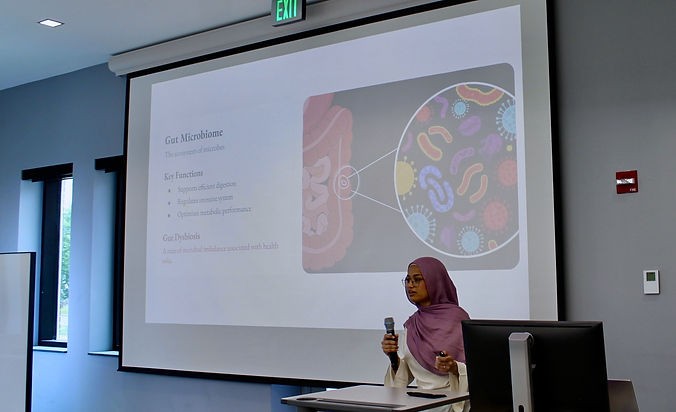
Caffeine Consumption, Anxiety, Gut Dysbiosis Risk, and Metabolic
Performance in Young Adults
Spring 2026 - Ongoing
Project Summary
Launched in Spring 2026 as a large-scale course-embedded research experience, this initiative expanded metabolic testing across nine Health and Wellness courses, with an anticipated enrollment of 160-200 students. The project was designed to generate a high-powered dataset capable of evaluating how stimulant use, psychological stress, diet quality, and gut health risk interact with measurable physiological performance outcomes.
Methods and Instrumenstration
All participants undergotesting using the COSMED Quark RMR-CPET metabolic
cart. Resting Metabolic Rate (RMR) was measured via indirect calorimetry using
a ventilated canopy hood system. Cardiorespiratory fitness is assessed using a
Graded Exercise Test (GXT) on a treadmill with an oronasal mask for breath-by-
breath gas analysis.
Behavioral and Dietary Assessments for participants include a
comprehensive battery of validated instruments:
-
Pittsburgh Sleep Quality Index (PSQI)
-
Gut Dysbiosis Risk Questionnaire (Dys-R)
-
Rapid Eating Assessment for Participants – Short Version (REAP-S v2)
-
Generalized Anxiety Disorder Scale (GAD-7)
-
Caffeine Consumption Habits and Expectancies Questionnaire (BCaff-EQ)
This integrated framework allowed evaluation of caffeine habits, anxiety burden, gut dysbiosis risk, dietary density, and sleep patterns alongside objective metabolic and aerobic outcomes.

A Pill to Keep Going: Early Biological
Signals of Renal Strain in Young Adults
Summer 2026 - Ongoing
Project Summary
The purpose of this proposed community-based study was to examine
associations between over-the-counter medication use, hydration behaviors, dietary protein intake, stress, socioeconomic factors, and early physiological indicators of kidney health in adolescents transitioning into adulthood.
Physiological Measures
Anthropometric assessments included height and weight for body mass index calculation. Resting blood pressure was measured under standardized seated conditions using a validated automated device.
The primary physiological outcome was point-of-care urinalysis using
dipstick analysis to assess:
-
Protein
-
Albumin (microalbumin when available)
-
Blood
-
Glucose
-
pH
-
Specific gravity
Albumin-specific strips allow the detection of early kidney stress indicators such as microalbuminuria.
Participants are to complete validated survey instruments assessing:
-
Physical activity (IPAQ-SF)
-
Headache frequency and severity (HIT-6)
-
Food security (USDA Self-Administered Module)
-
Over-the-counter NSAID use patterns (Medication Use Questionnaire)
-
Dietary protein intake (S-PFRQ)
-
Perceived stress (Perceived Stress Scale, PSS)